Gamebadges – Making Game Industry Competence Visible
The game industry is built on highly specialised skills, rapidly evolving roles, and project-based work that do not always fit neatly into traditional job titles. A “designer”, “producer”, or “programmer” can mean very different things depending on the studio, project, or even platform. As a result, it can be difficult to clearly communicate what professionals and students are actually capable of doing, especially when changing roles, entering the industry, or working across multiple disciplines.
Gamebadges was created to address this exact challenge by focusing on one central question: How can we make game industry competence visible and easily explainable?
At its core, Gamebadges aims to make game industry skills more visible, understandable, and portable, supporting professionals at different stages of their careers and contributing to a more transparent and connected industry.
A Competence-Based Approach Tailored to Game Development
Gamebadges is a competence-based Open Badge ecosystem designed specifically for the game industry. Instead of emphasising education paths, job titles, or years of experience, Gamebadges focuses on clearly defined, industry-relevant competences that reflect real professional work.
The Gamebadges ecosystem consists of two parts:
The Competence Map - Visualising a selection of game industry-specific professions and competences.
Available online: map.gamebadges.eu
9 Categories: Audio, Art, Business, Design, Marketing, Production, Programming, QA, & Industry-wide
40+ Skillsets (Descriptions of professional roles)
A brief description of the role
The competences required for the role
140+ Individual Competences
Representing specific expertise in three levels
The Open Badges - A tool for recognising and validating competences.
Currently in closed beta phase (accessible to a limited group of testers).
Applications are submitted through the Open Badge Passport.
Applications consist of real-life work examples or similar mock-ups.
Applications are evaluated by industry experts.
Badges are shareable across various digital channels and networks.
Both parts have been developed in collaboration with hundreds of industry professionals and educators during a yearlong preparation phase. The iteration of the ecosystem is ongoing until the end of 2026.
Gamebadges is run together with 9 partner organisations and supported by more than 20 associated partners, including game companies, across Europe.
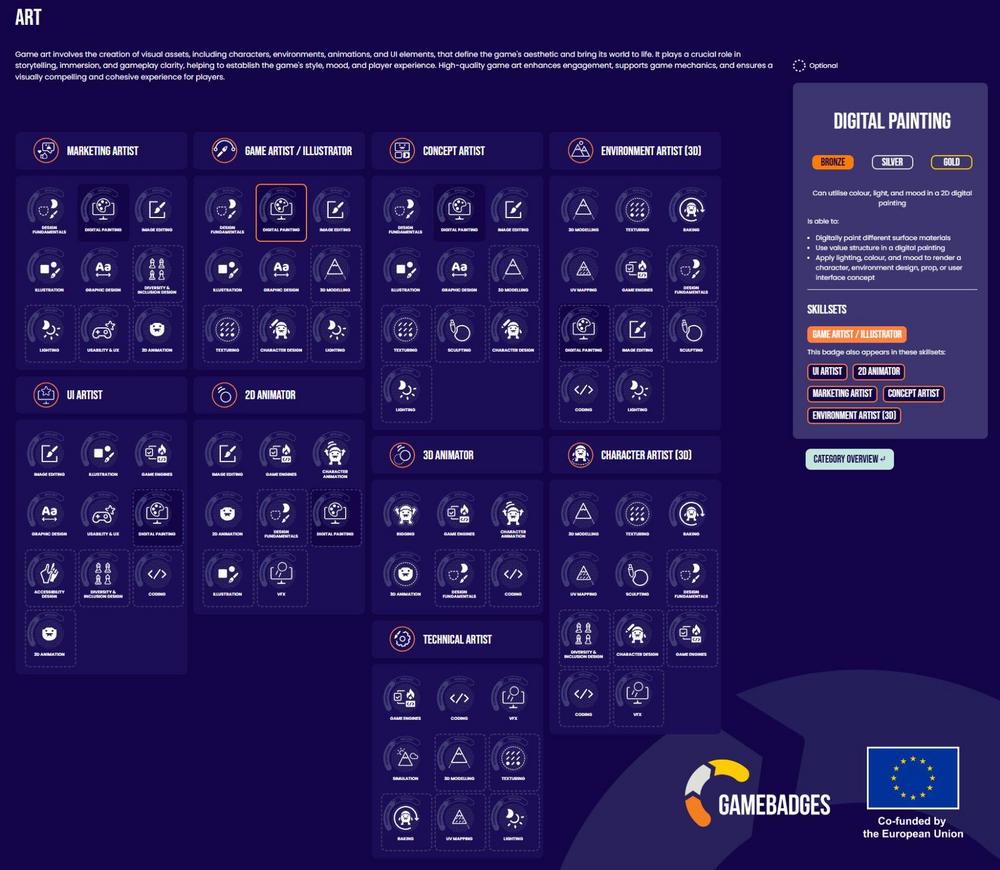
Picture above: View of the Art category of the Competence Map, including nine different skillsets and individual competences related to them.
How Gamebadges works in practice
Each Gamebadge is built around a standalone competence description. These descriptions focus on practical abilities, such as developing strategies, implementing systems, managing workflows, or producing concrete outputs relevant to game projects.
Descriptions are available in three different levels: Bronze, Silver & Gold.
Bronze: Represents basic and entry-level competences
Silver: Indicates an independent professional or senior-level expertise
Gold: Recognises guru-level mastery
Importantly, these levels are not cumulative. Applicants do not need to hold a lower-level badge to apply for a higher one. Each badge stands on its own and is evaluated independently.
To earn a badge, applicants demonstrate their competence through concrete evidence. This might include analyses, documentation, implementations, or other work that clearly shows their ability to perform the described tasks. The emphasis is always on demonstrable skills rather than theoretical knowledge.
A shared resource for professionals, studios, and educators
Gamebadges is designed to benefit the wider game industry ecosystem, not just individual professionals.
For game industry professionals, Gamebadges provides a way to make competences visible when job titles or portfolios alone are not enough. This can be especially valuable for junior professionals, specialists working in niche areas, indie developers wearing multiple hats, freelancers, or individuals transitioning between roles or sectors within the industry.
For studios and employers, Gamebadges offers a shared language for understanding competences across roles and teams. Clear competence descriptions can support recruitment, team composition, and internal skill development by making expectations and capabilities more transparent
For educators and training providers, Gamebadges helps bridge the gap between education and working life. Competence-based badges can support formal education and offer visibility to the concrete skills that students have gathered during their studies, but also offer a platform to showcase informal learning that happens outside the set curriculum; things they have learned during their internships, or as hobbyist game developers, in game jams or in other relevant projects. It offers recognisable, portable evidence of their skills.
Looking ahead
Gamebadges is an evolving ecosystem, developed in collaboration with game industry professionals and experts from multiple disciplines. As the industry changes, so too will the ecosystem.
If you want to be an early adopter of badges or have any questions, you can contact us via email: info@gamebadges.eu.
More Information
Homepage: https://gamebadges.eu
Competence Map: https://map.gamebadges.eu
Gamebadges LinkedIn: https://linkedin.com/company/gamebadges
Written by
Ria Gynther
Project Coordinator, Gamebadges - Skill Mapping and Micro-Credentials for the Game Industry, Metropolia University of Applied Sciences

Funded by the European Union. Views and opinions expressed are however those of the author(s) only and do not necessarily reflect those of the European Union or the European Education and Culture Executive Agency (EACEA). Neither the European Union nor EACEA can be held responsible for them.